Green Building
When building a new facility or renvoating an old one, it's important to incorporate sustainable materials, methods, and designs into the process to address proper use of resources, indoor air quality, and, you guessed it, energy efficiency and conservation! By designing and constructing a building or renovation with energy efficiency considerations, the result can be incredible savings on the monthly energy bill, and a facility that benefits both the people inside and the environment outside. Below you will find information on what green building is all about, as well as links to external websites that can provide you with further information.
|
|

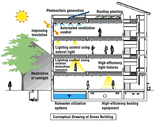
Important Aspects of Green, Energy Efficient Buildings
|
Building Codes
|
Third Party Commissioning
|
Funding Green Building
During these tough economic times for individuals, companies, and government we all have to tighten our belts, look for efficiencies to reduce costs, and explore all opportunities to raise revenue. Initiatives to green our existing building stock have the power to create new green jobs, increase sales and income tax revenues, as well as reduce utility costs for all Idahoans. And while implementing tax incentives to encourage individuals and companies to seek cost effective energy efficiency measures may not be feasible due to budgetary constraints, there are several alternative incremental steps that can be explored to encourage the private sector to invest in energy efficiency.
Of all of these, one of the best measures is for state government to lead by example and start implementing all cost effective measures to reduce utility costs incurred by the operation of state buildings. This is called the Paid from Savings Approach.
This has 3 main benefits to the state as well as the tax payer. The first benefit is that it will create or sustain green jobs. Secondly, it will raise tax revenue from both taxes on wages as well as sales tax on installed equipment. Third, it will reduce the annual amount spent on energy by the state, thus freeing up general fund for other programs.
As a first step, we would recommend the annual operating costs, with a breakout for utility costs, be provided to the Idaho Legislature. The second step will be for the state to direct an audit to be conducted at all buildings to determine cost effective options to reduce energy and water use. The third step will be for the state to allocate a portion of the operating budget to implement all measures with less than a 1 year payback period. This will allow the impact to the general fund to be negligible during these tough economic times. As the economy recovers, measures with payback periods up to 20 years should be implemented as government buildings typically have long life cycles so the savings can be realized. And while all buildings will see different savings, national data indicates that reductions in energy use for institutional buildings can be 30% and while water savings can be 50%.
You can see find information on the Paid from Savings Approach, funding mechanisms and the individual steps that need to be taken at:http://www.usgbc.org/ShowFile.aspx?DocumentID=6597
Other Options:
Contact:Leif Elgethun, USGBC Idaho Advocacy Committee Chair, [email protected]
Of all of these, one of the best measures is for state government to lead by example and start implementing all cost effective measures to reduce utility costs incurred by the operation of state buildings. This is called the Paid from Savings Approach.
This has 3 main benefits to the state as well as the tax payer. The first benefit is that it will create or sustain green jobs. Secondly, it will raise tax revenue from both taxes on wages as well as sales tax on installed equipment. Third, it will reduce the annual amount spent on energy by the state, thus freeing up general fund for other programs.
As a first step, we would recommend the annual operating costs, with a breakout for utility costs, be provided to the Idaho Legislature. The second step will be for the state to direct an audit to be conducted at all buildings to determine cost effective options to reduce energy and water use. The third step will be for the state to allocate a portion of the operating budget to implement all measures with less than a 1 year payback period. This will allow the impact to the general fund to be negligible during these tough economic times. As the economy recovers, measures with payback periods up to 20 years should be implemented as government buildings typically have long life cycles so the savings can be realized. And while all buildings will see different savings, national data indicates that reductions in energy use for institutional buildings can be 30% and while water savings can be 50%.
You can see find information on the Paid from Savings Approach, funding mechanisms and the individual steps that need to be taken at:http://www.usgbc.org/ShowFile.aspx?DocumentID=6597
Other Options:
- Mandate that all new state buildings over a certain square footage be required to use performance contracting to realize all cost effective savings.
- Remove barriers to innovative green building techniques proven across the country. We are currently working on identifying all barriers at a state and local level, either statutory or in agency rules.
Contact:Leif Elgethun, USGBC Idaho Advocacy Committee Chair, [email protected]
Online Resources
|
United States Green Building Council
|
International Code Council
|